Musical Theory for National Scholastic Junior All Star
Beat
The basic unit of time. It is the pulse of the music. It is the sound or feel that the listener taps their foot to when listening to music. In an ensemble the conductor establishes and controls the beat for the entire ensemble through his/her conducting pattern(s).
Simple and Compound Time
This is how the beat itself is divided into units (or sets) of time.
Simple Time
In Simple Time the beat is divided into two equal parts.
Compound Time
In Compound Time the beat is divided into three equal parts.
Time Signatures
Time signatures are how the beat is organized, measured, and represented.
The time signature indicates how may beats are in each measure and which type of note will represent one beat
The top number is commonly 2, 3, 4, or 6
The bottom number is commonly either 4 or 8
Simple Time Signatures divide the beat into groups of 2 and Compound Time Signatures divide the beat into groups of 3
How to Read a Time Signature
Time signatures consist of two elements: a top number and a bottom number. The top number tells us the number of beats in each measure. The bottom number tells us what note value those beats are. If the bottom number is a 4, it means the beats are quarter notes (four quarter notes in a measure). If the bottom number is a 2, it means the note value is half notes (two half notes per measure). And if the bottom number is an 8, it means the beats are 8th notes.
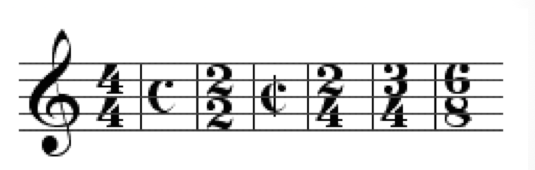
4/4 Time Signature or Common Time
Simple Time - The beat is divided by two
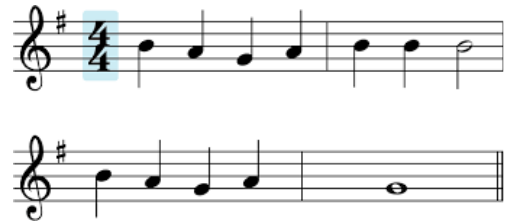
In a 4/4 time signature, there are four beats per measure and the quarter note receives one beat. A whole note takes up one entire measure in 4/4 time. Two half notes to complete a measure in 4/4 time. And there are 8, eighth notes in 4/4 for a full measure.
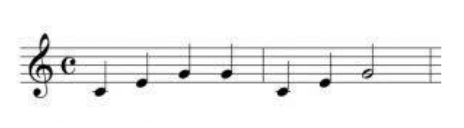
This is also known as “Common Time” because this is the most often written time signature in music. In fact, a 4/4 time signature is so common that it is often abbreviated at the start of a composition as a large C. This C stands for Common Time.
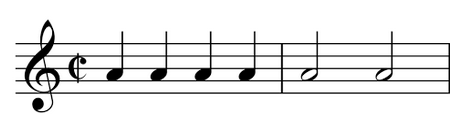
2/2 Time Signature or Cut Time
Simple Time - The beat is divided by two
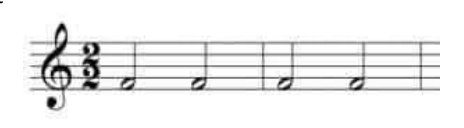
In 2/2 time signature each measure consists of two half notes with each half note receiving one count.
Cut Time is Common Time cut in half or the exact same as 2/2 time:
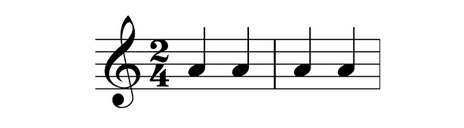
2/4 Time Signature
Simple Time - The beat is divided by two
In a 2/4 time signature, there are two beats per measure and a quarter note receives one count
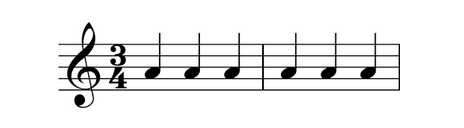
3/4 Time Signature
Simple Time - The beat is divided by two
3/4 is the most used time signature after 4/4 and 2/4. With three beats per measure, it creates a lilting (dance-like) style.
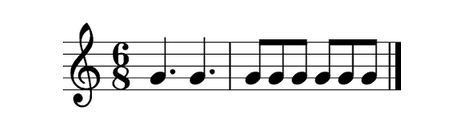
6/8 Time Signature
Compound Time - The beat is divided by three
The most common compound time is 6/8. In 6/8 time, there are six eighth notes in a measure and the eighth note receives one count. Generally, 6/8 time is divided into two groups of three eighth notes.